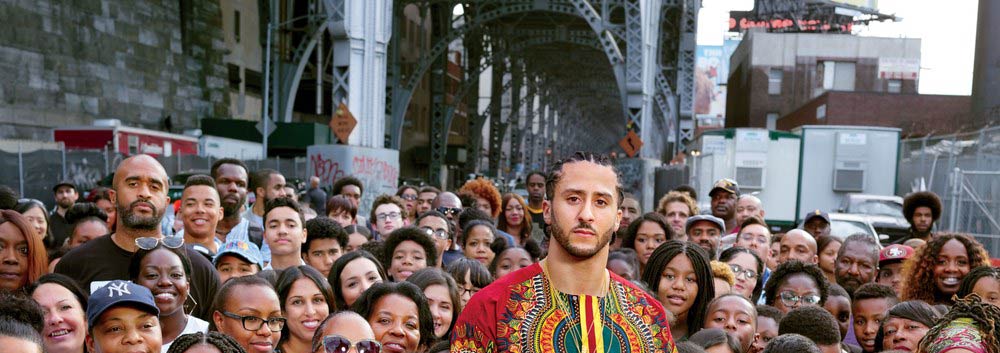
In the United States and abroad, athletes have fought for a variety of human rights causes such as racial, gender, and sexual equality, unionization and worker rights, peace and social justice, freedom from political persecution, ability rights, religious freedom, and free speech, among others.
Peter Kaufman and Eli A. Wolff 158
In 2016, San Francisco 49ers star quarterback, Colin Kaepernick sat through the singing of the National Anthem in a preseason game in an attempt to bring the issue of police brutality to everyone’s attention. Because of this bold stance by Kaepernick, he and the National Football League (NFL) are causing controversy and dividing the fan base. US Army Veteran Nate Boyer, wrote a letter to Kaepernick proposing that he protest in a different way because Boyer viewed this to be disrespectful to the flag. His comments are seen in this video:
Boyer respected Kaepernick’s stance, but did not agree with his approach. Kaepernick and Boyer exchanged letters and finally met each other to try to find a better way for Kaepernick to express his stance. Boyer believed that sitting during the National Anthem was disrespectful to the flag. Once Boyer understood Kaepernick’s goals he realized the bigger issue of police brutality, now supporting his stance and suggesting that Kaepernick take a knee instead of sitting. Boyer believed that kneeling was actually a sign of respect. People kneel to pray and show respect for those who served our country. Even though Kaepernick and Boyer agreed, it would not be the end of the controversy.
Some people think that athletes such as Kaepernick are disrespecting our country by kneeling during the National Anthem. As a result, the sports community has become divided. However, this is not necessarily the case. I believe the athletes are just expressing their views and outside forces are causing a divide among the sports community. The role of sports is to bring people together, even among fans with different political beliefs.
I believe that the role of sports is changing in our society. Before these protests began, people used sports to connect with each other and leave all other differences behind. Now, some people are using sports as another method to divide the country. The founding fathers wanted each individual to be able to express their beliefs without consequences, just as Kaepernick is doing when he kneels for the National Anthem.
This is not the first time professional athletes have protested. We see it all throughout history, as sociology scholars Peter Kaufman and Eli A. Wolff explain,
Indeed, there is a long list of athletes who have experienced such a reaction after publicly proclaiming their political convictions on the playing field: Tommie Smith and John Carlos (and Peter Norman), Muhammad Ali, Mahmoud Abdul-Rauf, Carlos Delgado, Toni Smith, Steve Nash, Marco Lokar, Etan Thomas, and Craig Hodges, among others.
Kaufman and Wolff 156
These athletes used their celebrity status to draw attention to injustice in their community. Kaepernick is representing African American men by advocating for each of them and the respect they deserve.
This act of protesting is not just seen in professional sports, but has been seen in college sports as well. In 1998, the University of California, Los Angeles (UCLA) football team wore black wristbands in a nationally televised game against the University of Miami. As Kaufman and Wolff explain, the wrist bands, “were meant to symbolize the team’s opposition to Proposition 209 which aimed to end affirmative action in higher education in California”(Kaufman and Wolff 156). These players also used their position to draw attention to what was important to them on a national stage.
Ramogi Huma, a UCLA player at the time and founder of the National College Players Association (NCPA), said in an interview:
That’s what it was all about. Really the idea was for us to make some kind of statement and use our platform because the Miami game was going to have national coverage. The idea was that we could use the game to bring awareness to the situation.
qtd. in Kaufman and Wolff 160
The UCLA players used this protest to make people aware of Proposition 209 and the impact it would have on California as a whole.
One of the major issues in America today is how innocent young African American men are being mistaken for someone who is armed. Unfortunately too many young men are dying at the hands of police officers. This is the reason why players like Kaepernick take a knee during the National Anthem. In the New York Times article, “The Deafening Silence of Colin Kaepernick”, he further explains his position:
As police officers continue to terrorize black and brown communities, abusing their power, and then hiding behind their blue wall of silence, and laws that allow for them to kill us with virtual impunity, I have realized that our love, that sometimes manifests as black rage, is a beautiful form of defiance against a system that seeks to suppress our humanity. A system that wants us to hate ourselves.
qtd. in Hoffman and Minsberg
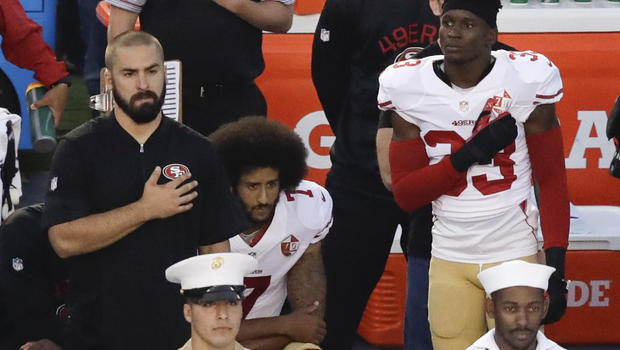
By kneeling during the National Anthem, Kaepernick is bringing the issue of police brutality to a national stage. This is unbearable for families of police brutality victims, knowing that their loved one will never come home again all because of a misjudgement or mistaken identity. Kaepernick wants to let the public know what these families go through and wants people to realize that a change needs to be made, to prevent similar tragedies from happening.
Other athletes are beginning to follow Kaepernick’s lead, such as former Carolina Panthers Safety Ed Reid. He told Dan Cancian of Newsweek:
People who don’t want things to change, people who want to maintain the status quo […] they have to subvert. They have to distract. They have to redirect from what we’re trying to accomplish. We have to stay strong. We have to stay diligent.
qtd. in Dan Cancian
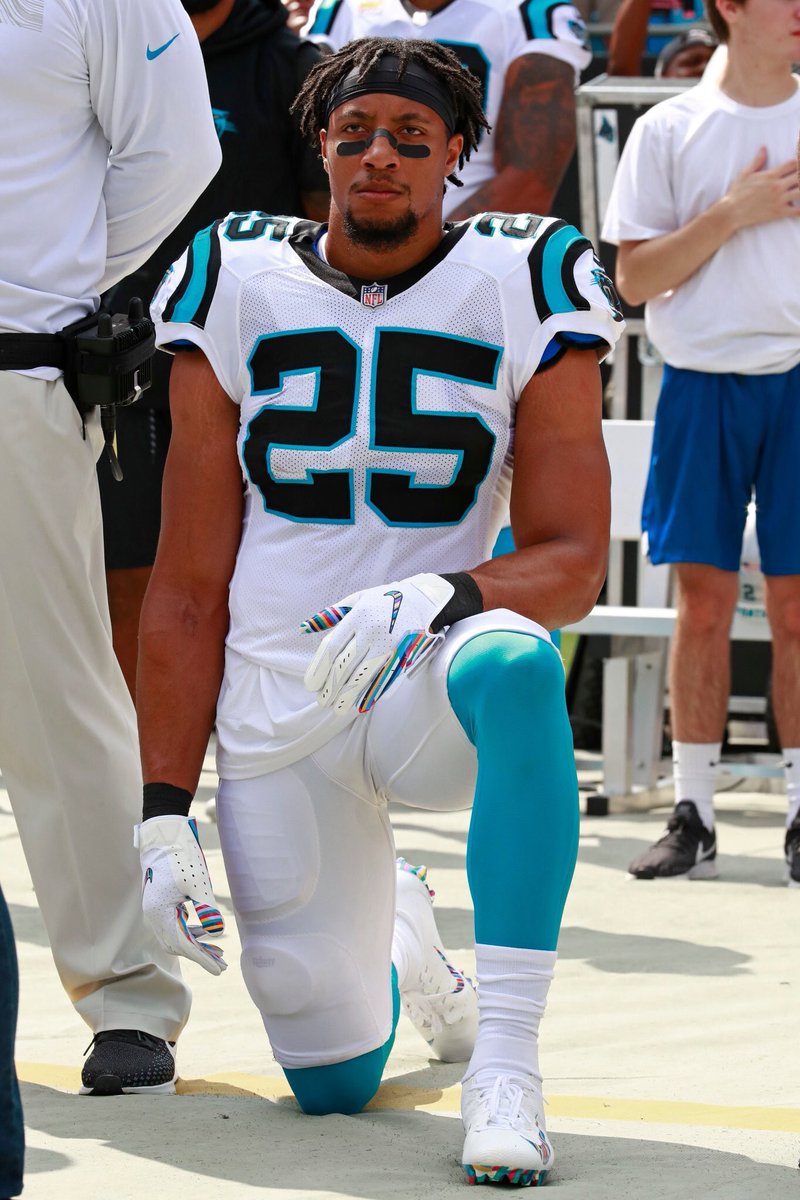
Reid is joining Kaepernick, trying to make a point that this is an important issue for them and needs to be resolved in order to protect innocent lives. Both Reid and Kaepernick, along with other players, understand that some people may not like their method of protest but most people agree that police brutality needs to be stopped.
These players are trying to make a statement and hoping that politicians will listen to them, understand the issue, and take appropriate action. Unfortunately, our President Donald Trump, did not give them the support they were looking for, and instead added fuel to the fire. He explained himself in a speech he gave in Alabama in September of 2017.
Instead of sympathizing with Kaepernick and the other players, Trump blew the whole issued out of proportion. In contradiction to Boyer’s stance, Trump believes that these players are disrespecting the United States’ flag and even called for NFL owners to fire the players who were protesting.
It is not just Trump who is speaking out against this issue, other people within the sports community are as well. Hall of Famer, former Cleveland Browns Running Back,
and now reporter for CBS Sports, Jim Brown, told Sports Digital Editor, Bryan Flaherty, of the Washington Post,
I am with [Kaepernick] 100 percent. … Now if you ask me ‘Would I do that?’ No I won’t, because I see it a little differently. I’m an American citizen, I pay my taxes, I want my equal rights but this is my country, and consequently I don’t want to open up for ISIS or anybody that will take away what we’ve already gained.
qtd. in Flaherty
Brown has an interesting take, in the sense that he is both agreeing and disagreeing with Kaepernick at the same time. He is agreeing with Kaepernick in the sense that this issue is a real problem and needs to be resolved. What he does not agree with is the method of protest. Like many others, Brown believes kneeling during the National Anthem is disrespectful.
New Orleans quarterback Drew Brees has voiced a similar position, as he told Flaherty,
qtd. in Flaherty
I disagree. I wholeheartedly disagree. Not that [Kaepernick] wants to speak out about a very important issue. No, he can speak out about a very important issue. But there’s plenty of other ways that you can do that in a peaceful manner that doesn’t involve being disrespectful to the American flag.
With these three perspectives, from Boyer, Brown, and Brees, they are not saying that Kaepernick should not stand up to combat this important issue. They are just saying his method is not very appropriate. The American flag represents a great country where every opinion is welcome but there is still ongoing debate on how people can best express their opinion.
Members of the National Basketball Association (NBA) also had their opinions on the protests and the controversy that followed. NBA star LeBron James told Jason Concepcion of the The Ringer,
qtd. in Jason Concepcion
The thing that frustrated me and pissed me off a little bit is the fact that [Trump] used the sports platform to try to divide us, and sports is so, so amazing, …What sports can do for everyone, no matter the shape or size or race or ethnicity or religion or whatever. People find teams, people find players, people find colors because of sport, and they just gravitate toward that and they just make them so happy. And it brings people together like none other.
James made a great point. Trump is trying to use sports and these protests specifically to divide the country. He is not looking at both perspectives like Boyer, Brees, and Brown did, separating the issue of police brutality from the method of kneeling during the National Anthem. Trump himself, has never commented on the actual issue being protested and has only talked about the method of protest.
I believe, along with James, that sports are the only thing that bring everyone together. We saw this in action on April 15, 2013, when the city of Boston was shook after the Boston Marathon bombings. Days after this tragedy, Red Sox designated hitter, David Ortiz, gave a speech to the fans:
This speech by Ortiz, was considered to be the turning point after the bombings. The speech brought people together in times of tragedy and later that season the Red Soxs won the World Series. This exemplifies the impact that sports has on people and society as a whole. For our President to use this as a mode of divisiveness goes against everything sports and these athletes stand for.
Both the NFL and NBA have different approaches on how their respective players are allowed to protest. One of the major differences is that the NBA encourages individuality while, the NFL encourages uniformity. This is because both organizations have different modes of representation. Former Press Secretary under the Clinton Administration and former Chief Communications Officer for the NFL, Joe Lockhart, told journalist, John Branch, of The New York Times, “’The superstar players in the N.B.A. are also the leaders in the union, and they have enormous influence and are a very cohesive group’”(qtd. in Branch). In other words, the NBA’s representation is the players. Since this league is significantly smaller than the NFL it is easier to have a say about particular issues.
An example of this would be the recent I Can’t Breathe movement by the NBA. The NBA players wore shirts that said “I Can’t Breathe” during pregame warm ups in protest of police brutality. Former shooting guard Kobe Bryant said to Senior sports writer J.A. Adande,
qtd. in Adande
But that’s what our nation was founded on. We have the ability to question these things, and in a peaceful fashion. And that’s what makes us a great country.
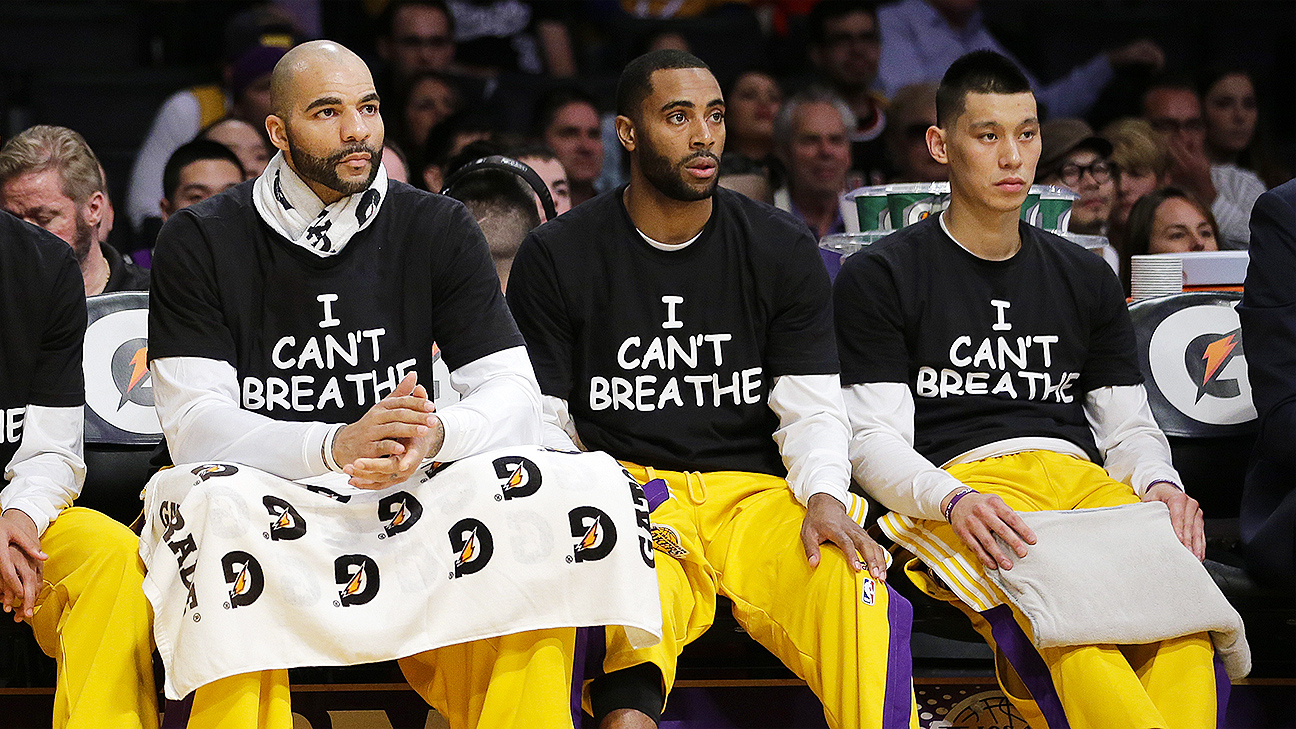
This shows that NBA players have more freedom of speech than players in the NFL. Since NBA players are members of their union, they can shape some of the communication policies in order to have their voices heard. The NFL players, on the other hand are represented by a union of which they do not belong. This means that they do not have any control over what they can and cannot say or do.
This idea leads into how the front office management and league offices react to players protesting on the field and on the court, and the effects on their league ratings. According to Branch, “N.B.A. contracts, generally, are guaranteed; N.F.L. contracts are not. In most cases, teams can cut players without paying the remainder of the contract.”(Branch). This is a really important point. If a NFL player violates a term in his contract the team has the right to terminate him.
In reference to NFL commissioner Roger Goodell, NFL Digital Content Editor, Austin Knoblauch, explained that, “Goodell said the NFL wouldn’t force players to stand for the national anthem even though the league believed they should stand”(Knoblauch). Goodell looked at both sides of this issue and respected what Kaepernick was doing even though other people throughout the league did not like Kaepernick’s actions.
The unfortunate thing about what Goodell tried, hearing both side of the issue, is that there was still a lot of backlash. President Trump as seen in the video above, put pressure on Goodell and team owners to make a change in the way players present themselves during the National Anthem. As a result, this past off-season the NFL introduced a new policy requiring that each player and staff member stand during the National Anthem. As Knoblauch explains, “The NFL will enact a national anthem policy for 2018 that requires players and league personnel on the sideline to stand but gives them the option to remain in the locker room if they don’t want to stand”(Knoblauch). This is limiting the players’ rights to speak out against an issue facing our country. Branch said in response to this new policy:
It was another top-down attempt at stamping out a controversy. The N.F.L. Players Association said it was not consulted.
Branch
With this action by the NFL, you can clearly see how the NFL and the NBA run things differently. NBA players have the right to speak out and disagree in front of their fans to bring attention to issue they think are important whereas NFL players’ rights are limited because of outside influences.
Kaepernick is not playing football anymore, because he would not comply with the new National Anthem policy. He has, however, partnered with Nike to continue to speak out about police brutality. Recently, Nike released an ad supporting Kaepernick’s mission as seen in the following video:
This is a very powerful ad as Kaepernick explains to follow your dreams even if it means sacrificing everything. He did just that. He took what is important to him and stood up to it, even once he could no longer play in the NFL.
These outside influences are changing the role of sports in our society. Currently this issue of the way players are protesting is now becoming a political debate, dividing people instead of bringing people together. With the political climate currently it is easy for people to disagree with each other. If we go back to when sports brought people together, just like the 2013 Red Sox’s season did for the city of Boston, we can have a sense of unity in this country. If we look at Kaepernick’s protest of kneeling for the National Anthem, as not disrespectful to our flag, but an attempt to bring attention to an important issue, we can work on finding a solution that does not divide the country.
Work Cited
Adande, J.A. “Purpose of ‘I Can’t Breathe’ T-Shirts.” ESPN, ESPN Internet Ventures, 10 Dec. 2014, http://www.espn.com/nba/story/_/id/12010612/nba-stars-making-statement-wearing-breathe-shirts.
Branch, John. “Why the N.F.L. and the N.B.A. Are So Far Apart on Social Justice Stances.” The New York Times, The New York Times, 22 June 2018, http://www.nytimes.com/2018/06/22/sports/nfl-nba-social-justice-protests.html.
“Bryan Flaherty.” The Washington Post, WP Company, http://www.washingtonpost.com/people/bryan-flaherty/?utm_term=.ea4ca26c7038.
Cancian, Dan. “Eric Reid Knelt during the National Anthem on His NFL Return.” Newsweek, 8 Oct. 2018, http://www.newsweek.com/eric-reid-returns-nfl-kneels-during-national-anthem-1157268.
CNN. “Trump: I Wish NFL Owners Respected US Flag.” YouTube, YouTube, 23 Sept. 2017, http://www.youtube.com/watch?v=8JMnfmxA_Qo.
Concepcion, Jason. “Why the NBA Trumps the NFL on Athlete Activism.” The Ringer, The Ringer, 27 Sept. 2017, http://www.theringer.com/nba/2017/9/27/16372580/nba-nfl-trump-activism.
Flaherty, Bryan. “From Kaepernick Sitting to Trump’s Fiery Comments: NFL’s Anthem Protests Have Spurred Discussion.” The Washington Post, WP Company, 24 Sept. 2017, http://www.washingtonpost.com/graphics/2017/sports/colin-kaepernick-national-anthem-protests-and-NFL-activism-in-quotes/?utm_term=.4ee550504856.
Hoffman, Benjamin. “Benjamin Hoffman.” The New York Times, The New York Times, 17 Dec. 2018, http://www.nytimes.com/by/benjamin-hoffman.
Hoffman, Benjamin, and Talya Minsberg. “The Deafening Silence of Colin Kaepernick.” The New York Times, The New York Times, 4 Sept. 2018, http://www.nytimes.com/2018/09/04/sports/colin-kaepernick-nfl-anthem-kneeling.html.
“Jason Concepcion.” The Ringer, The Ringer, http://www.theringer.com/authors/jason-concepcion.
Kaufman, Peter, and Eli A Wolff. “Playing and Protesting: Sport as a Vehicle for Social Change.” Journal of Sport and Social Issues, pp. 154–175. SPORTDiscus, eds.a.ebscohost.com/eds/detail/detail?vid=3&sid=195c6184-9131-4bf6-86d9-bf9eeb6c30c7@sdc-v-sessmgr05&bdata=JnNpdGU9ZWRzLWxpdmUmc2NvcGU9c2l0ZQ==#db=s3h&AN=50544135.
Knoblauch, Austin. “NFL Owners Approve National Anthem Policy for 2018.” NFL.com
History, National Football League, 23 May 2018, http://www.nfl.com/news/story/0ap3000000933971/article/nfl-owners-approve-national-anthem-policy-for-2018.
Minsberg, Talya, et al. “Talya Minsberg.” The New York Times, The New York Times, 13 Dec. 2018, http://www.nytimes.com/by/talya-minsberg.
MLB. “David Ortiz Rallies the Boston Crowd after Boston Marathon Tragedy.” YouTube, YouTube, 20 Apr. 2013, http://www.youtube.com/watch?v=1NttSTenyEk&feature=youtu.be.
Orfalea, Matt. YouTube, YouTube, 9 Oct. 2017, http://www.youtube.com/watch?v=I4nyaL8qmK0&feature=youtu.be.
Person. “Roger Goodell’s Statement on National Anthem Policy.” NFL.com History, National Football League, 23 May 2018, http://www.nfl.com/news/story/0ap3000000933962/article/roger-goodells-statement-on-national-anthem-policy.
Schoeller, Martin. “Colin Kaepernick Will Not Be Silenced.” GQ, GQ, 13 Nov. 2017, http://www.gq.com/story/colin-kaepernick-will-not-be-silenced.
Sport, Guardian. “Nike Releases Full Ad Featuring Colin Kaepernick.” YouTube, YouTube, 7 Sept. 2018, http://www.youtube.com/watch?v=-grjIUWKoBA&feature=youtu.be.

 Are athletes social stands dividing people